


Choosing Spider Farmer SF or SE: panel or bar fixture?
Choose Spider Farmer LED by fixture shape, space and actual power. Compare SF panels, slim SF-300 and SF-600 lights and SE bar fixtures without confusing model numbers with wattage.
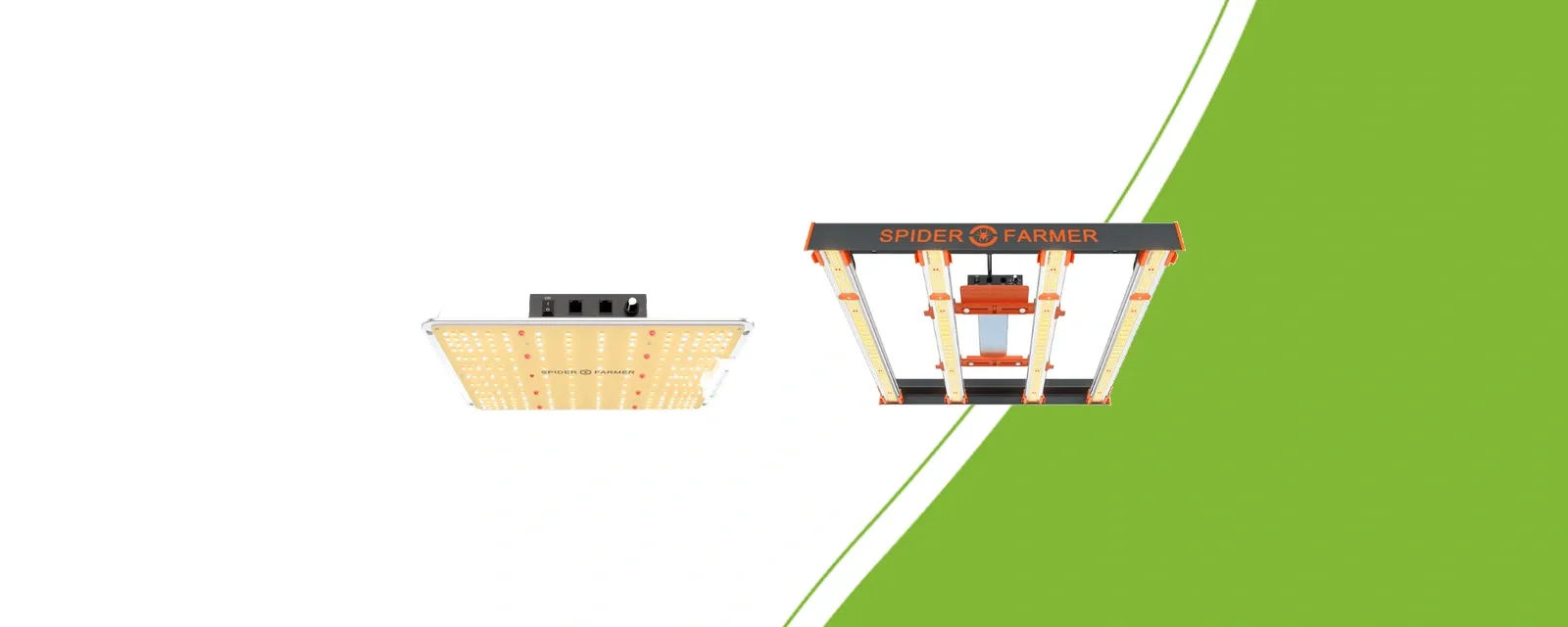
Start with the shape of your growing area
Measure the internal width and depth of your space, then record the clearance above mature plants. Allow room for the light, hanging hardware and cables. A fixture may physically fit yet leave corners poorly lit. We therefore choose Spider Farmer LED by size and distribution together.
A narrow propagation shelf calls for a different design from a broad canopy in a tent. Decide whether you need propagation lighting, a full growing cycle or an addition to an existing setup.
SF includes more than one type of panel
The 33 W SF-300 and 74 W SF-600 are slim lights to consider for propagation areas and narrow plant arrangements. They differ from the larger SF panels. Do not treat the entire series as one design offered at different wattages.
The SF-1000 is a 100 W panel. SF-2000 and SF-2000PRO are both rated at 200 W but differ in shape: SF-2000 is more elongated, PRO more compact. SF-4000 is a 450 W panel. Compare dimensions and distribution at your hanging height. Explore the existing SF-Series selection for these models.
When should you consider SE bar fixtures?
SE lights distribute their LEDs over several bars. The offered ratings are 300 W for SE-3000, 480 W for SE-5000, 730 W for SE-7000 and 1000 W for SE-1000W. Consider this series when you want a bar design and have enough hanging clearance.
More power does not solve every dark corner. Position, distance and the relationship between fixture and growing area influence where light lands. Assess PPFD at several points across the crop, including the edges. One peak reading under the centre says little about the rest of the setup.
Separate model names, wattage and running costs
SF-1000 does not mean a 1000 W input. Use nominal power for an initial comparison and measure actual input for running costs. The formula is watts ÷ 1000 × operating hours = kWh. At an actual 200 W input for twelve hours, consumption is 2.4 kWh.
Dimming can change input power. Include the complete light and driver, then calculate extraction and circulation separately. Do not treat an HPS replacement claim as equivalent to measured LED consumption.
Check the version and controls before expanding
A model name can refer to different generations. Check the exact version, dimmer, driver and any external control. Do not assume app control, diode specifications or cable compatibility from another model.
Does the fixture fit with hanging hardware and cables?
Does light reach the edges at a usable height?
Does the available intensity suit your plants and growth stage?
What control method does the exact version support?
Can you manage heat and air movement?
Refine placement with our Spider Farmer hanging height and dimming guide. If you are deciding between two models, tell us your space dimensions and clearance so we can assess the choice properly.