


Switching from HPS to LED: check your whole setup
Hanging an LED fixture is one step. Use this checklist to reassess mounting, power, controls and climate when replacing an HPS setup.
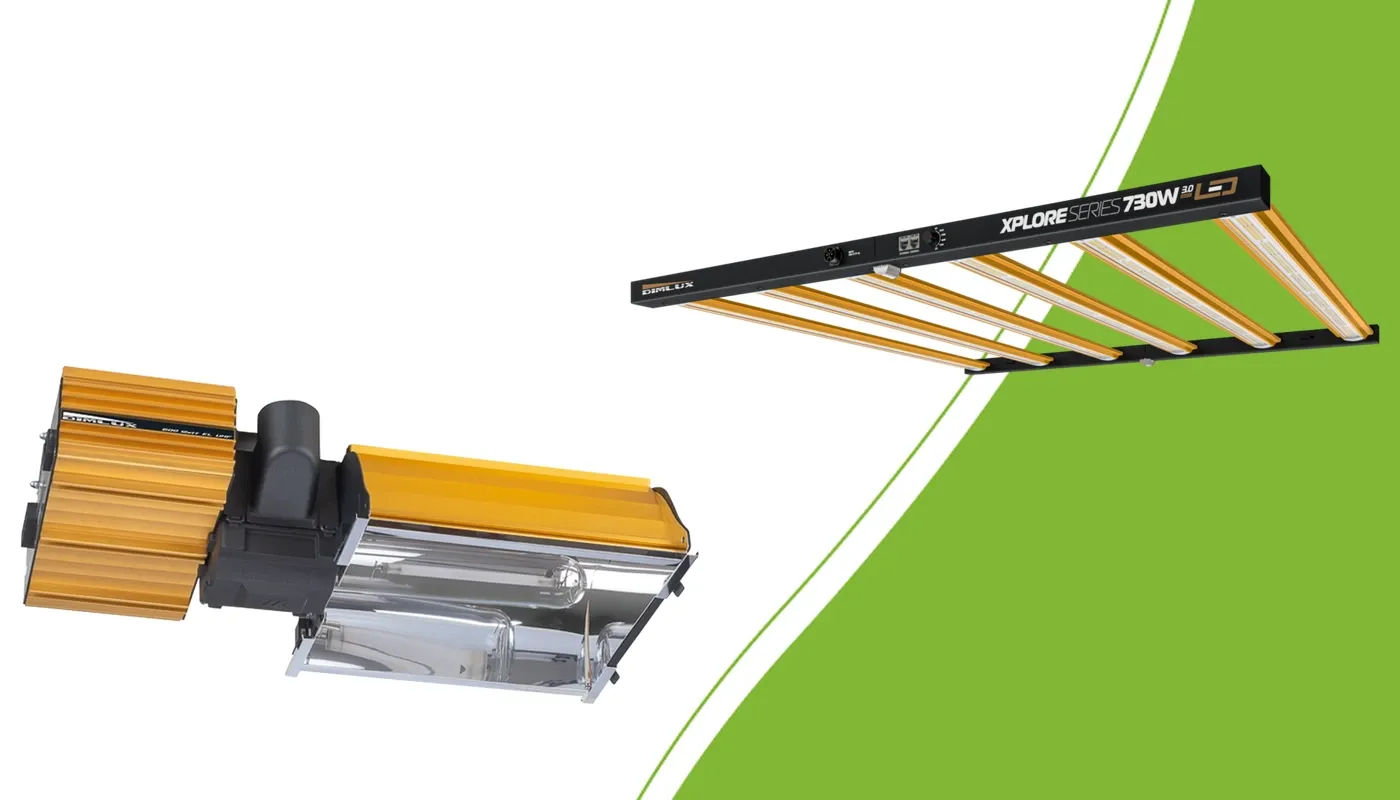
Record the existing installation
Note the growing area, available height, hanging hardware, bulb and ballast. Record how you control lighting hours and ventilation too. This identifies the parts that belong to the current HPS installation and those that need reassessing for LED.
Compare LED grow lights with your existing Complete HPS fixtures. Choose by distribution and usable space. A lower model wattage alone does not prove equal lighting across your plants.
Check the mechanical fit
Measure the LED fixture and allow room for hanging points, driver and cables. Check frame or ceiling load capacity and use appropriate hanging hardware. A bar fixture can be wider than the HPS reflector it replaces.
DimLux Xplore 730W and Lumatek ZEUS are examples of bar fixtures in our range. Use information for the exact model; one series can include different layouts and generations.
Plan power again
An HPS ballast is not an LED driver. Use the power supply and cord intended for the LED fixture. Check input voltage, grounding and total installation load. Record actual input power for electricity calculations.
Calculate watts ÷ 1000 × operating hours for kWh. At an actual 600W for 10 hours, this gives 6 kWh. This calculation covers the light alone and does not prescribe a lighting schedule. Add ventilation and other equipment separately.
Verify the control connection
Do not connect an existing HPS controller to an LED without checking. Record protocol, generation, plug and required cables. Explore Grow light controllers after establishing which controls the fixture supports. Identical plugs do not make two systems interchangeable.
Assess light and climate after mounting
Use the LED model’s light map at the appropriate height and dimming setting. Check the whole growing area, including the edges. Begin with settings suitable for the plant stage and change one factor at a time.
Reassess temperature, humidity, leaf temperature and air movement. Light and heat distribution change when the source changes. The old ventilation setting is therefore not automatically the right choice.
Keep the new starting conditions
Record model, position, height, dimming, controller and lighting hours. Check cables and operation after changes. Use the DimLux light plan for more on PPFD maps, or explore Grow lights to compare other lighting options.