


DimLux LED light plan: size, PPFD and energy use
Plan DimLux Xplore or Xtreme MKII lighting: measure your space, assess PPFD maps and calculate energy use from actual input power.
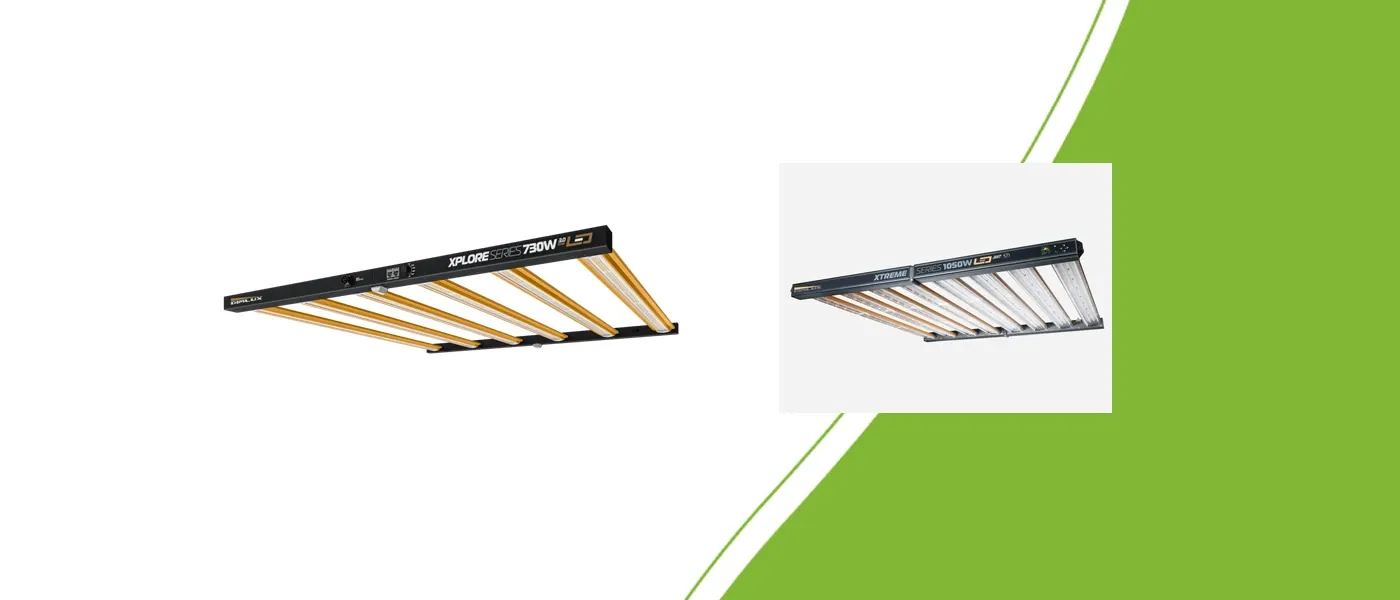
Measure the growing area and available height
A DimLux LED light plan starts where the light arrives. Measure the length and width of the growing area and record the free height above the crop. An area measuring 1.2 by 1.2 metres equals 1.44 square metres. A tent’s outer dimensions do not show how much space remains for hanging hardware, ventilation and cables.
Draw the fixture to scale in your layout. Allow for the necessary clearances and decide whether you will use one light or several fixtures together. A high wattage in the model name alone does not prove suitable distribution across your area.
Record the exact DimLux version
The LED range includes Xplore CompactLine 100W and 200W, Xplore 730W standard and 9X in 2.7 and 3.0 versions, and Xtreme MKII 550W, 800W and 1050W with NIR. Write down the complete product name. This prevents using a light map or mounting recommendation for a different generation.
The original Xplore 2.7 measures 1063 × 1118 × 54 mm in standard form and 900 × 960 × 54 mm as 9X. These dimensions apply to that generation. Do not assume they apply to other versions; assess distribution across the growing area too.
Read a PPFD map as a measurement setup
PPF describes photon output from the source. PPFD describes the light per square metre arriving at a measurement plane, expressed in µmol/m²/s. Check the area, mounting height, dimming setting and measurement conditions behind a map. Compare maps with comparable assumptions.
Look at the average as well as edges and corners. One high central reading does not explain uniformity across the whole growing area. With several fixtures, overlap changes. A map for one light is therefore not automatically a lighting plan for the entire room.
Separate PAR from total light output
Check the wavelength range behind a figure. PAR over 400–700 nm and a total over 350–800 nm including NIR use different boundaries. Do not compare them as if they measured the same thing. NIR is also not another name for UV.
Xtreme MKII + NIR offers an adjustable spectrum. Record the spectrum setting as well as intensity when documenting a measurement. Use the data and controls for the exact model.
Calculate daily consumption from input power
Use this calculation: input power in watts ÷ 1000 × operating hours per day = kWh per day. An example at an actual 730W for 12 hours gives 0.730 × 12 = 8.76 kWh per day. This is an arithmetic example, not a recommended lighting schedule or guaranteed consumption for every 730W version.
When dimming, use the corresponding input power or a measurement. Do not assume that a dimming percentage produces exactly the same percentage of electricity use. Multiply calculated consumption by your own electricity tariff when comparing costs.
Check and keep the lighting plan
Keep model, position, mounting height, lighting hours, dimming setting and measurements together. After installation, check operation and assess distribution again across the actual growing area. Repeat this after changing height or layout.
Include leaf temperature and ventilation in your assessment. Light output, air conditions and leaf temperature jointly influence the growing environment. Record your starting conditions and assess changes one at a time.