


Choosing OCL LED: Skwid 1560 PRO, 1900 PRO, ECO or Balaena?
Four OCL LED models, two power ratings and different fixture layouts. Compare Skwid and Balaena for space, light distribution, control and energy use.
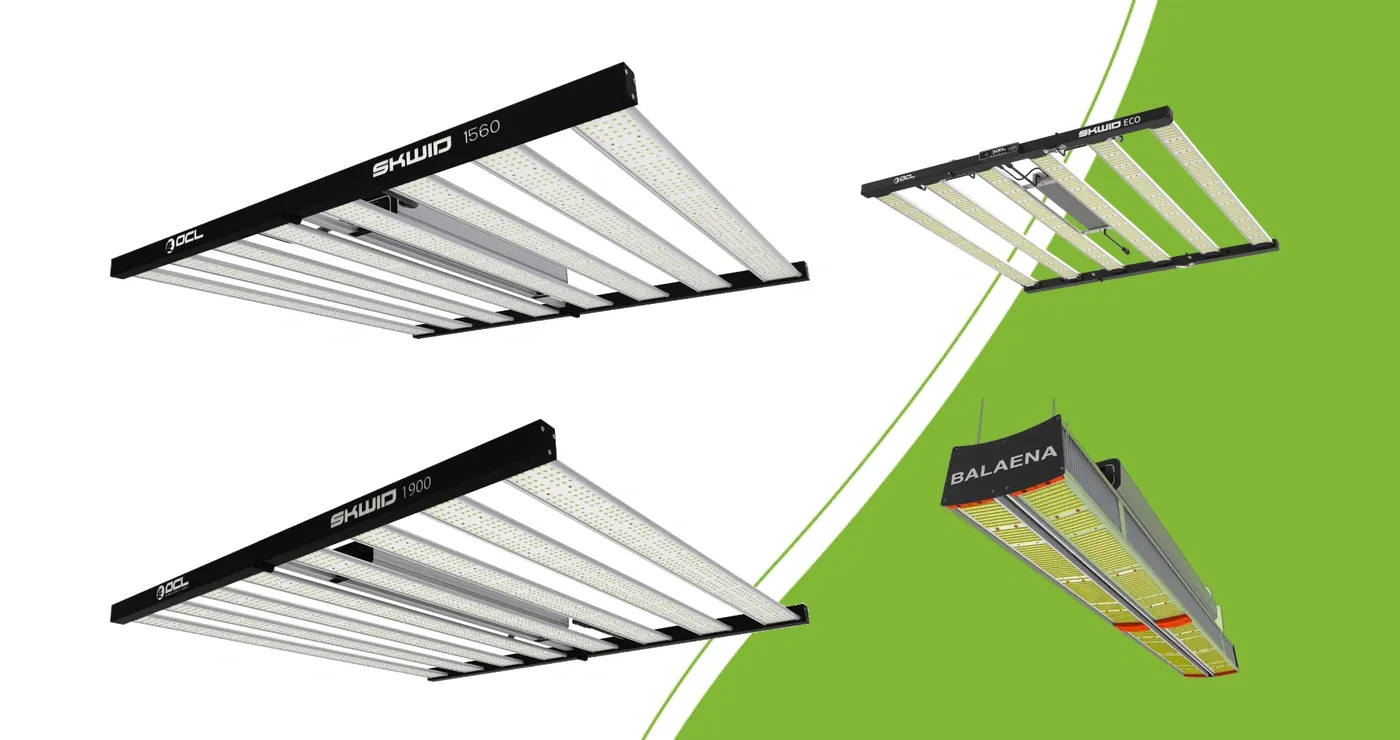
Start with your space and plants
Choose an OCL LED grow light around your growing area, headroom and plant light requirements. Note the internal width and depth. Establish the clearance left above the crop once pots, plants and suspension are in place. Allow for cables, airflow and access to your plants.
Then compare the four models. Skwid 1560 PRO is rated at 520W. Skwid 1900 PRO, Skwid ECO and Balaena are in the 680W class. This distinction helps you plan electrical power, but does not establish how much light each plant receives.
Skwid PRO, ECO and Balaena: choose the layout
Skwid 1560 PRO 520W: a wide bar fixture. Consider this model when you want a 520W rating with a broad bar arrangement.
Skwid 1900 PRO 680W: a wide bar fixture in a higher power class. Check the exact version and mounting clearance.
Skwid ECO 680W: a folding bar frame. Plan around its unfolded dimensions and suspension points.
Balaena 680W: an elongated layout. Assess how that shape suits your supports and plant arrangement.
Use the product pictures to recognise the layout. Relative sizes in a composition are not dimensions. Confirm the outside dimensions of the version you order, especially in a tight space.
Compare light where the plants stand
PPF describes total photon output. PPFD describes light intensity on an area. For your choice, distribution across the entire growing area matters: centre, edges and corners. A high central reading does not demonstrate even coverage.
Choose hanging height and dimming together. Work within the mounting and operating requirements of the chosen model and account for plant species and growth stage. Use a suitable PPFD meter and record sensor height, lamp distance and dimming. Change one setting at a time so you can assess its effect.
520W or 680W: calculate energy use
The formula is actual input power in watts ÷ 1000 × operating hours. At an actual input of 520W, twelve hours of lighting uses 6.24 kWh. At 680W it uses 8.16 kWh. The difference in this example is 1.92 kWh per twelve hours. Multiply by your own electricity rate for the cost.
These figures are calculations using assumed input, not measurements of a fixture. A 50% dimming setting does not prove exactly half the wall power. Measure the input if you need precise figures, and add ventilation and other equipment separately.
Check control before ordering
Do you want manual dimming or central control? Fixture, driver, control signal and cable must work together. A plug that fits or a shared brand name is insufficient. Compare grow light controllers with the exact model and version to hand.
When replacing HPS lighting, recheck mounting, connections and electrical load too. For the broader decision, read our guide to choosing LED or HPS.
Your buying checklist
Measure width, depth and available headroom.
Choose the layout and confirm outside dimensions.
Assess distribution at a usable height and dimming setting.
Check control, cables and mounting.
Plan energy use with actual input and operating hours.
Compare current models in our OCL LED range. Tell us your space dimensions and intended model if you would like help matching the setup.