


Lumen King ECO Controller or Master Controller: how to choose
Choose a Lumen King controller around the exact fixture, control signal and lighting groups you need. Assess whether ECO controls or a Master Controller suit your setup.
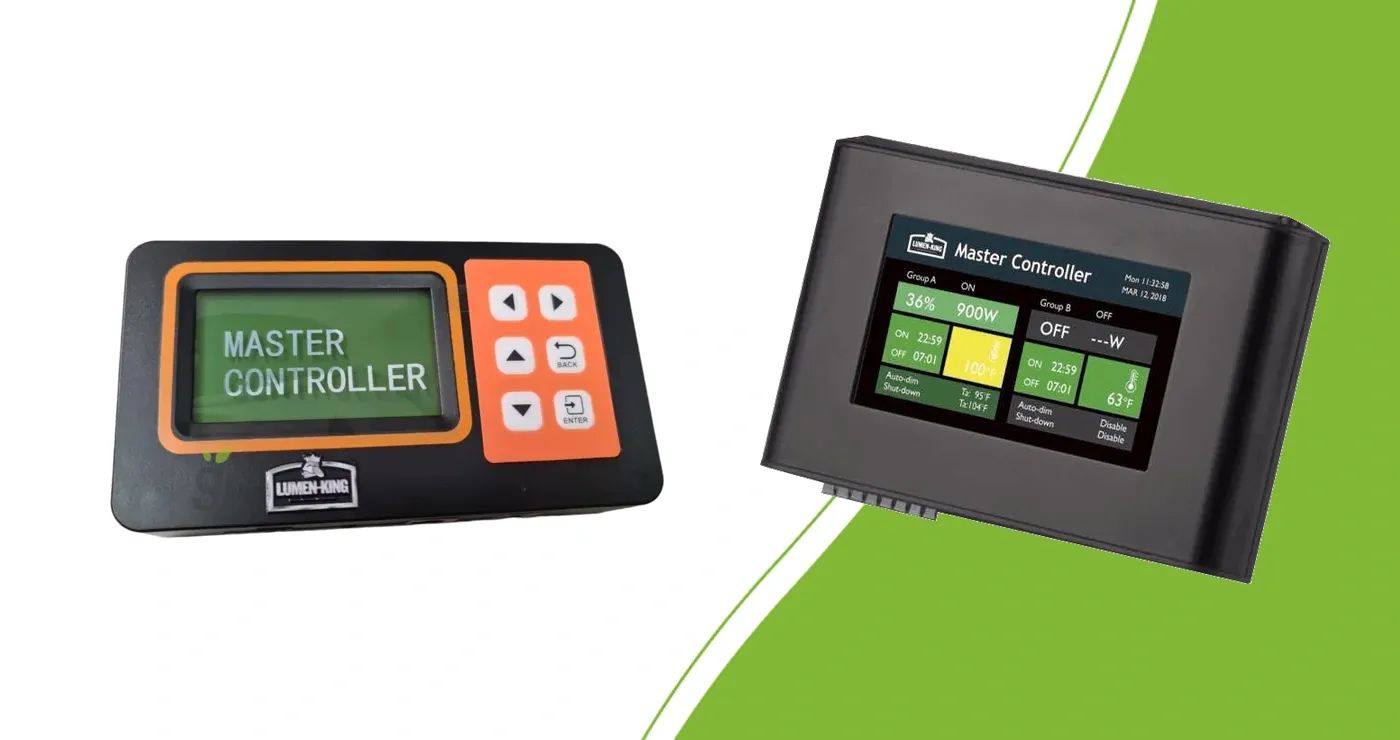
Identify the exact fixture and supply
A controller signals the lighting; it does not replace the ballast or driver. Record the full Lumen King LED model, supply version and control port. A matching RJ connector does not prove compatibility: signal, cable pinout and adjustment range must also agree.
Next, decide whether you need one shared lighting schedule or two independently controlled groups. The number of fixtures and linking arrangement matter too. Then compare the ECO Controller and Master Controller.
When does the ECO Controller fit?
The ECO Controller provides central lighting control with a timer, dimming, temperature protection and sunrise/sunset adjustment. It is a focused choice for a compatible ECO setup needing a shared lighting pattern.
Verify the supported fixture combination and the maximum connected devices for your exact controller version. Having 0–10V and PWM connections does not make a controller universal. A port for a different signal is not automatically a second independently programmable schedule.
When should you choose the Master Controller?
The Master Controller has two programmable lighting groups. This is useful when zones need different on/off times or dimming settings. Each group can be assessed and set individually rather than forcing all lighting to follow the same program.
Plan which fixtures belong to group A, which belong to group B and the settings required for each. Check supported fixtures, cable length and permitted load per group. A maximum fixture count is not the electrical capacity of a socket or circuit.
Check five points before connecting
Model and generation: keep the 630W, ECO and other versions distinct.
Control protocol: establish the signal accepted by the fixture and supply.
Cables: match both connector and pinout.
Control mode: select external control when the supply requires it.
Groups: record which lights share a program and which need independent operation.
Connect control cables with the installation disconnected from power. Use a suitable supply for the controller itself. An ordinary network cable or adapter is not a proven replacement for the intended control lead. Have uncertain combinations checked before switching on.
Set timing and temperature protection deliberately
Check the clock, schedule and configured power class before starting an automatic cycle. Verify that fixtures actually respond as intended. Assess behaviour after a power interruption within the capabilities of your controller version.
Place the temperature sensor representatively near the crop, away from direct heat from drivers or fixtures. Set dimming and shutdown thresholds around plant and climate requirements. Temperature protection is an additional control; adequate ventilation remains fundamental. Investigate repeated temperature-triggered dimming rather than simply raising the threshold.
Finish with a lighting check
Correct controller settings do not establish adequate canopy coverage. Recheck height, dimming and distribution after connecting. When expanding, compare ECO power options and choose fixtures that work together in a suitable lighting plan.