


Lumatek ATS PRO or ZEUS: choosing an LED for your setup
Choose your Lumatek LED by dimensions, light distribution and control. Learn when to compare Attis/ATS PRO, ZEUS 465W, the 600W generations or a 1000W version.
Start with space and light requirements
Choose an LED fixture as part of a lighting plan. Measure the available length, width and height and decide where your plants will sit. Leave room for suspension, air circulation and access. A fixture that fits inside the tent does not automatically deliver the required intensity everywhere.
Distinguish total light output, PPF, from the intensity at plant level, PPFD. For PPFD, check measurement height and conditions as well. A central peak tells you little about the edges. Compare light maps under similar conditions.
When should you compare compact ATS PRO models?
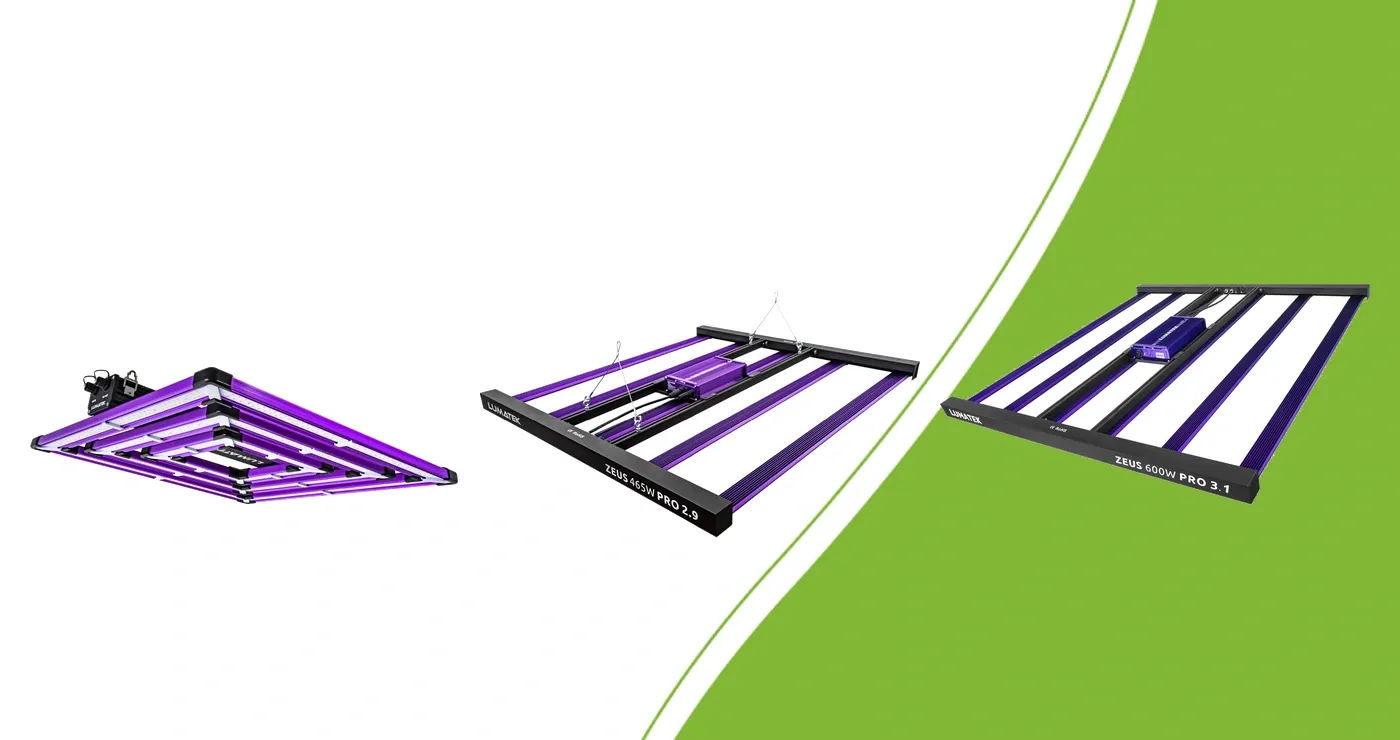
The Attis 200W PRO and 300W PRO in our range belong to the ATS PRO family, with model codes LUMLED200P and LUMLED300P. These compact fixtures are a useful starting point when installation space is limited. Compare dimensions, light output and dimming range.
Also consider the remaining space between the fixture and your plants. A higher model wattage does not correct uneven distribution. Match your choice to the light requirements at each growth stage and the room available for height adjustments.
ZEUS 465W and 600W: keep generations separate
ZEUS uses an open bar layout. The 465W PRO 2.9 is a different version from the 600W 2.6, 600W PRO 2.9 and 600W PRO 3.1. Model suffixes matter: they distinguish generations with different light output and efficiency.
For example, the ZEUS 600W PRO 3.1 delivers 1990 µmol/s PPF and draws 640 W at full output, with an efficacy of 3.1 µmol/J. Apply these values only to that version. Compare energy use using input power and the same daily operating hours.
1000W PRO EVO and XTREME serve different layouts
For the 1000W versions, compare frame shape and intended light distribution first. PRO EVO uses a wide rectangular layout. XTREME versions target high light intensity and need a suitable climate and lighting plan.
Before buying, assess whether your plants can use that intensity, how heat will be removed and whether CO₂ control is part of the setup. Choose a 1000W model based on those factors together. Selecting the highest output alone does not complete the decision.
Treat control and UV as separate decisions
For external control, check the exact fixture, 0–10V support where applicable and the correct control cable. Decide which lights should follow the same programme. Similar connectors do not confirm a matching signal or pinout.
The 30W UV bar supplements suitable main lighting; it is not an alternative to ATS PRO or ZEUS. It provides UV-A/UV-B and cannot be dimmed. Assess the combination separately and follow safety instructions for positioning, operation and preventing exposure.
Check your choice in five steps
Measure free space and plan suspension and ventilation.
Select the exact range and generation, including its suffix.
Compare PPF, distribution and input power.
Check dimming, controller and cables for that version.
Adjust height and dimming to your plants after installation.
Browse the Lumatek LED range to compare available versions. Still deciding on lighting technology? Read our LED or HPS guide.