


Collapsible or rigid water tank: which suits your setup?
Tank construction affects placement, empty storage and maintenance. Compare collapsible and rigid water tanks by the space and access you need in daily use.
Start with how you will use the tank
Will the tank stay in one position, or do you regularly pack the setup away? Will it only hold a prepared supply, or must a pump sit inside it? These questions make the choice between collapsible and rigid tanks practical. Calculate capacity separately with our water supply sizing guide.
A nutrient reservoir should fit your daily routine. You need to inspect its level, mix the solution and remove deposits. Choosing the largest volume for the price can leave you with a tank that is awkward to reach or maintain.
Collapsible tanks store compactly when empty
A collapsible Aquaking water tank has a flexible wall and can be packed down when empty. When filled, it needs its full diameter and height. Collapsible construction does not reduce the floor space required during operation.
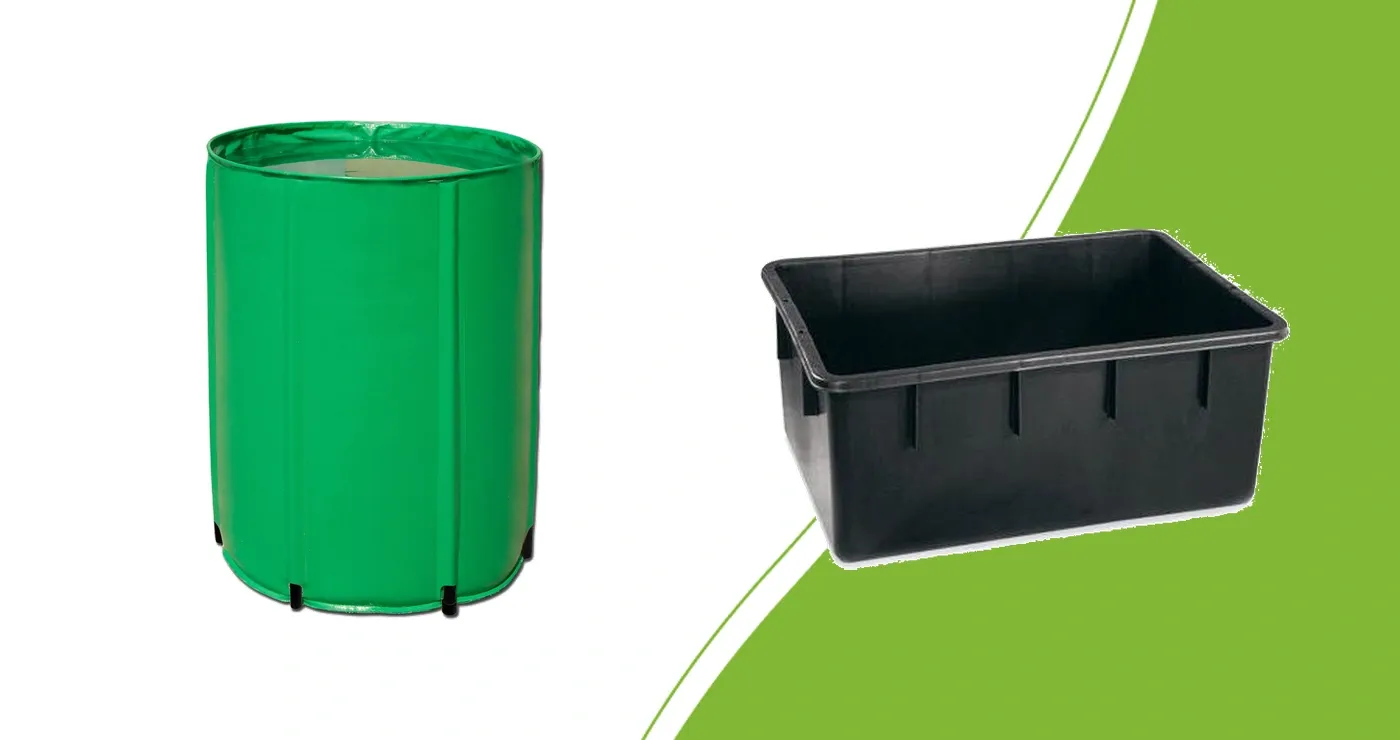
The 160-litre Aquaking collapsible tank measures Ø 50 × 90 cm and has a PVC wall, closing top, outlet tap and overflow. The 100-litre model measures Ø 40 × 80 cm. Allow extra space for its hose, tap and opening the top.
Rigid containers retain their shape
A rigid tank keeps its shape when empty. Its footprint is predictable, but it cannot be folded like a flexible tank. A rectangular container may fit a particular corner more conveniently. Compare actual outside dimensions before ordering rather than relying on volume alone.
Consider a black 65-litre rectangular tank alongside a green 200-litre rectangular tank with lid. Do not assume that every version includes a lid or the same connections. A wide open top can improve access, while also requiring attention to covering and contamination.
Check pump and cleaning access
Measure whether the pump fits through the opening and can be removed later. Account for its cable, hose and minimum operating level. An outlet tap does not replace a pump when the installation requires pressure or lift. Select a water pump for the complete delivery route.
Check that you can clean the bottom, corners and connections. A tank may fit beneath a bench yet lack the clearance needed for maintenance. Keep closures and fittings within reach instead of building them into an inaccessible corner.
Position the tank before filling it
Place the empty tank on a level, suitable load-bearing base. A 160-litre fill weighs approximately 160 kilograms before adding the container and equipment. Assess the support for the whole installation. Do not move a filled flexible tank by pulling on its wall, tap or upper edge.
Test connections with clean water and inspect for leaks. Then choose the water tank that matches your supply and working space. A regular approach to cleaning and refilling makes the complete system easier to inspect.