


CO2 Bag or gas generator: which suits your space?
A CO2 Bag and a gas generator both supply carbon dioxide, but need different setups. Compare fuel supply, heat, ventilation and monitoring before choosing.
Written by Jesper van der Weide
Start with your space and measurements
Before choosing an extra CO2 source, find out how the space is ventilated and how temperature and CO2 concentration behave. Note when extraction runs, where air enters and how warm the room gets with the lights on. Use a CO2 meter in a suitable position. Follow the meter instructions for sensor placement; do not measure only beside the source.
A higher supply rate is not automatically a better setting. Strong air exchange can quickly remove added CO2. The installation must still provide adequate ventilation and heat removal. Assess the source and room climate together.
What does a CO2 Bag need?
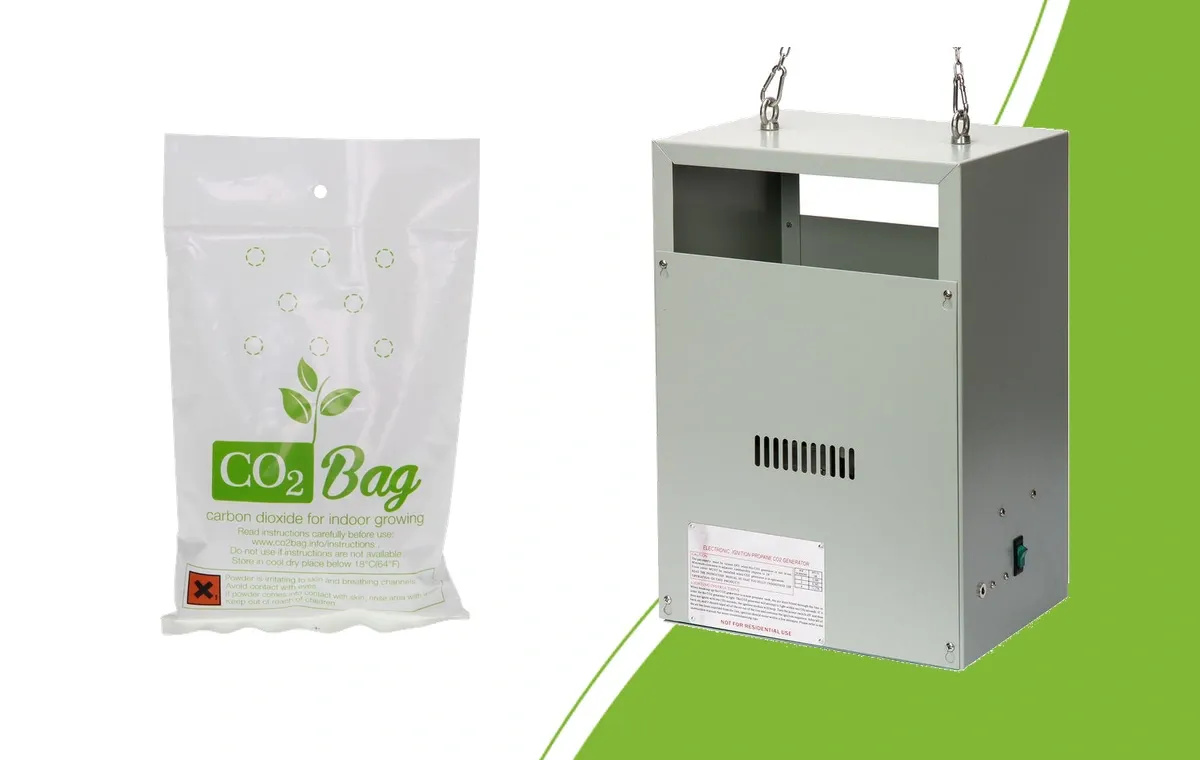
The CO2 Bag releases carbon dioxide from a compact bag. There is no gas burner and no need to install a natural gas or propane connection. That gives it different installation requirements from a gas generator. It is also not a device for setting an exact CO2 concentration.
Follow the pack instructions for opening it. Hang the bag in a dry place above plant height, but not directly over plants. Keep it outside the direct extraction airflow and measure the result in your space. The bag remains a CO2 source; it does not replace a meter or climate controls.
What does a gas generator need?
A CO2 generator burns gas and produces heat as well. Our CO2 equipment range includes Autopilot units listed at 4 and 8 kW, Biogreen units at 4 kW and a Hotbox at 11 kW. These kW figures describe heat output. They do not establish a fixed CO2 concentration or growing area.
First have the proposed placement, gas supply and heat removal assessed for the space. A burner is not an automatic choice for a small grow tent. Clearances, mounting and fuel supply depend on the instructions for the exact model. Have a qualified professional check the installation.
Choose the fuel version before ordering
Natural gas and propane are separate versions. The Autopilot 4 kW natural gas and Autopilot 4 kW propane carry the same power designation but use different fuel supplies. A hose that fits does not establish compatibility. Check the burner version, pressure and connections for the unit supplied too.
Apply the same checks to Biogreen and Hotbox. Do not assume universal fuel conversion or a complete included control kit. Establish the required fuel version and connection parts before buying.
A meter, controller and source have different jobs
A CO2 meter displays the concentration. A suitable CO2 controller can operate a compatible source. The bag or generator supplies the CO2. These functions are not interchangeable. Check the sensor, output, maximum load and fault behaviour of a controller against your exact combination.
A ventilation climate controller is not automatically a CO2 controller. Use only a verified compatible connection. Retain necessary ventilation and safeguards, and check conditions before entering a space with CO2 supply.
Gather the information that helps you choose
Collect room dimensions, ventilation details, temperature readings, CO2 measurements and the available gas supply. Use them to compare installation needs. Consider the bag when exploring an approach without a gas burner; consider a generator only where fuel, heat removal and placement are suitable. Explore the available CO2 sources and bring those details when asking for advice.