


Which meters do you need for water, substrate and air?
Start with the medium and the way you want to measure. Liquid meters, substrate probes and climate sensors answer different questions. Use this guide to build a suitable measuring kit.
Start with the question you need to answer
Do you want to check acidity in nutrient solution, follow its conductivity or measure room temperature? Write down the required measurements before choosing a device. pH, EC, temperature and relative humidity are separate measurements. One reading does not replace another.
Nutrient solution: separate meters or a combo meter
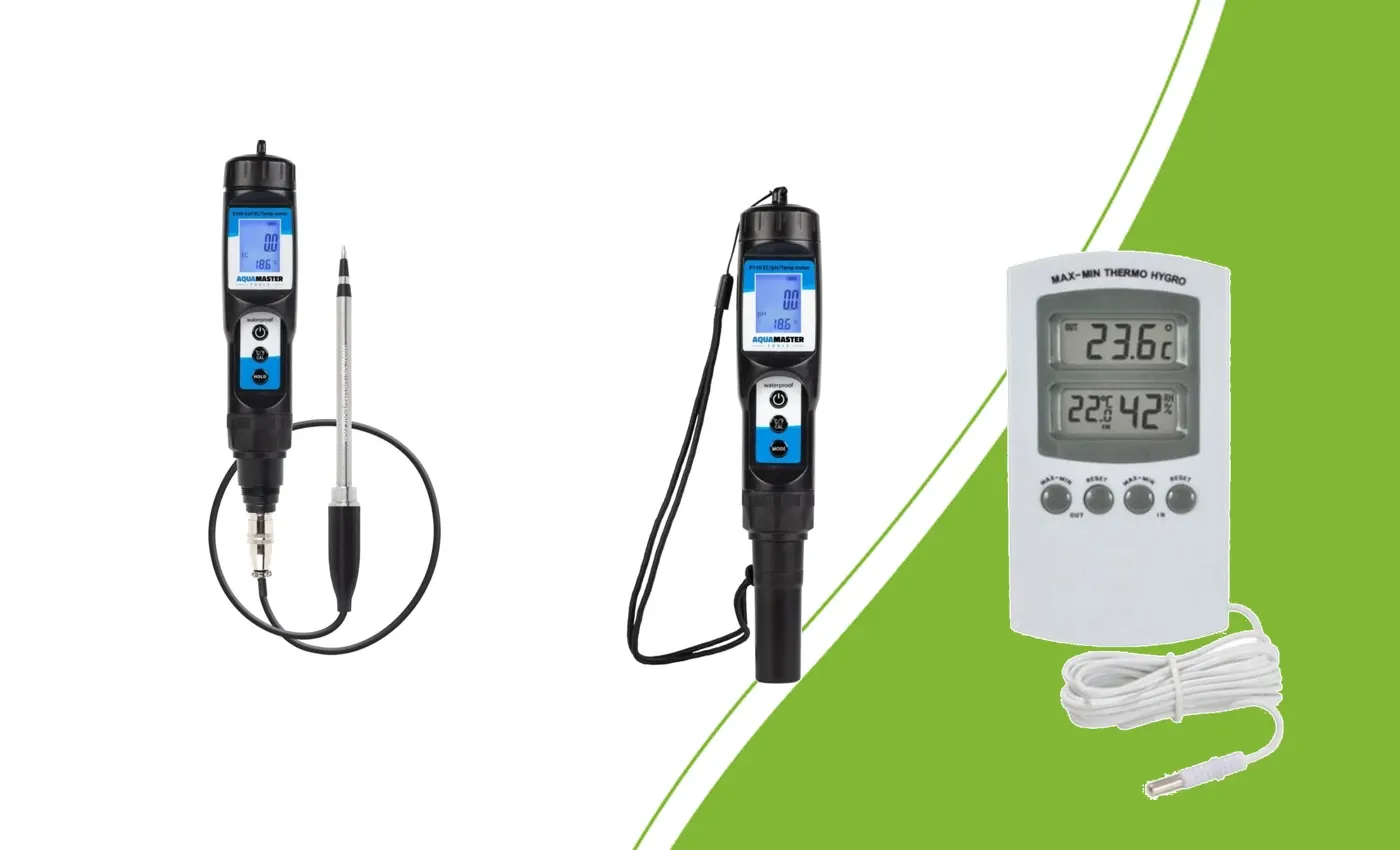
A separate pH meter such as Milwaukee PH51 performs a specific measurement. Checking both pH and EC requires two suitable meters or a combo meter. Aqua Master Tools P110 Pro combines pH, EC and temperature in a pen. P700 Pro2 uses a separate display unit with connected electrodes. Choose the format that suits spot readings or a fixed measuring position.
Substrate: choose a suitable probe
A standard liquid pen is not automatically suitable for inserting into soil or coco. Our range includes Aqua Master Tools E300 pro and S300 pro2 for direct substrate measurements. They measure different parameters: E300 pro is for EC and temperature; S300 pro2 is for pH and temperature. Decide which value you need first.
Air: distinguish a meter from a sensor
A digital thermo-hygrometer with a display shows temperature and relative humidity. A separate control-system sensor needs a suitable controller or display unit. CO₂ sensors work on the same principle. The Techgrow T-Micro does not include a sensor. Check the complete box contents and the exact control system.
Plan the measuring routine and maintenance
Use a consistent position and method. Record the medium, unit and time so you can compare results. Prepare suitable reference solutions, clean containers and any required storage solution. Check the electrode type: some pH probes need to remain hydrated; others are designed for dry storage.
Make your selection specific
Decide on the medium, required parameters and use: spot checks or a fixed measuring position. Then check probe, connection, power supply and maintenance procedure. Share those details with us if you are unsure about a combination. They allow us to give more useful advice than a general request for the best meter.
Choose your next step
Measuring & calibration for your grow room · pH & EC meters · Aqua Master Tools meters · Thermo-hygrometers · CO2 meters · Calibration solutions
Calibrating a pH meter and storing its electrode · EC, mS/cm, µS/cm and ppm: compare readings correctly