


How to hang and use a drying net: a practical checklist
A suitable drying net starts with enough clear space and a sound setup. Use this checklist to inspect the hanging point, spread your material and monitor airflow and moisture.
1. Measure the clear space first
Measure the usable width, depth and height where the net will hang. Allow for the hanging point and access to every tier. Nominal tent dimensions do not show how much space remains between equipment and the frame.
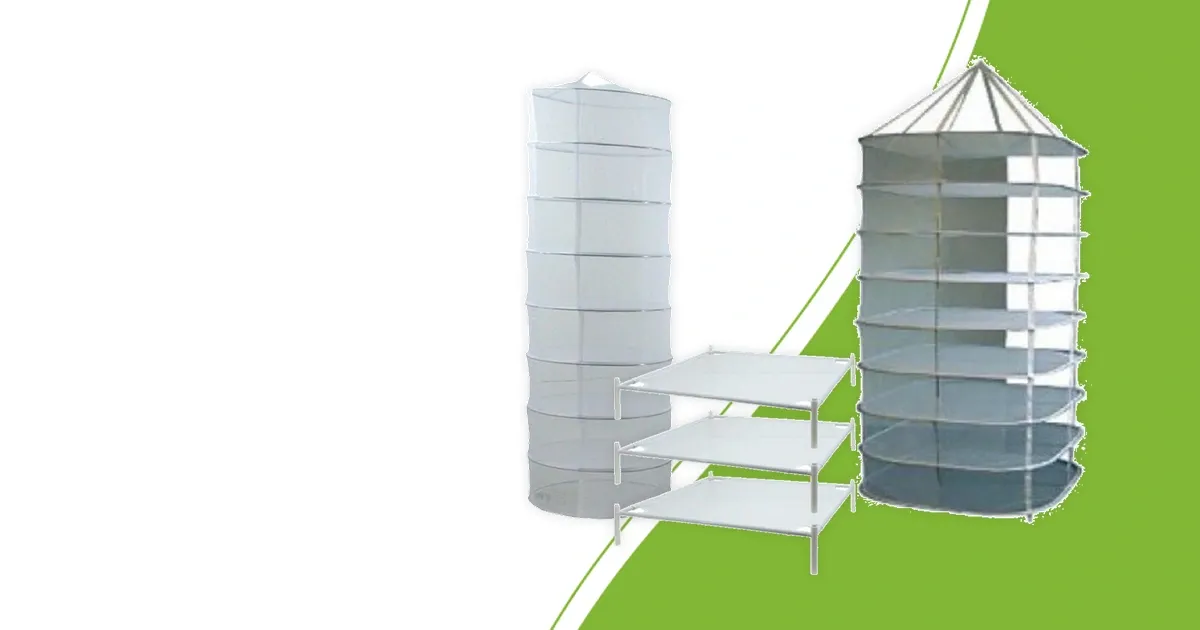
Our drying net range includes 60 and 80 cm round hanging models, an 80 × 80 cm square model and a stackable 71 × 71 cm rack. The three hanging models have eight tiers. Choose a shape that can hang freely and that you can reach easily.
2. Check the hanging point or base
Use a hanging point suited to the net and its load during use. Check attachments, seams and straps before filling. Keep the net away from walls and equipment and follow the assembly instructions for your model. Do not attach it to a cable or hose.
Using the stackable drying rack? Place it on a stable, level base and check that each rack sits securely on the next. Use the number of racks you need and keep the setup accessible.
3. Spread material thinly across the tiers
Prepare material in a way suited to the particular plant. Where needed, use harvest scissors to separate pieces. Spread small portions and avoid thick piles. Leave gaps so you can inspect the pieces and air can reach them.
Distribute the load across the tiers. Keep different materials separate if they dry differently. There is no fixed weight that suits every net and material: size, moisture content and spreading determine the space you need.
4. Monitor airflow and humidity
Mesh supports the material and lets air through. It does not control the drying climate. Provide gentle airflow around the setup and a route for moist air to leave. Avoid directing a circulation fan as a strong jet at a single tier.
Use a thermo-hygrometer to track temperature and relative humidity. Suitable conditions and drying time depend on the material. Do not use a single fixed duration for all herbs or flowers. Our guide to humidity control explains measurement and ventilation in more detail.
5. Inspect every tier regularly
Check whether pieces touch, retain damp patches or load the tiers unevenly. Adjust the distribution and airflow if drying is uneven. Keep batches separate so you can assess each one.
Move to packaging and storage only when the material is suitable for the chosen storage method. A dry surface alone does not confirm that the inside is sufficiently dry.
6. Clean and store dry
Remove debris after use and clean in a way suited to the mesh material and care instructions. Let the net dry fully before putting it away. Before the next use, check the mesh, frame, seams and hanging parts again. Replace damaged parts or resolve an unstable stack first.