


Grow tent fan placement: mounting and airflow
Good fan placement starts with firm support and an unobstructed airflow. We explain how circulation works alongside extraction and how to assess a wall fan for your setup.
Plan circulation and fresh air exchange separately
Identify two jobs before installing a fan. A circulation fan keeps air moving inside your tent or room. Extraction removes air and needs a supply of replacement air. Allow for both when planning the space: a wall fan alone is not a complete ventilation system.
Mark the positions of plants, lights, ducts and cables. Find a point where airflow can travel across the plants without immediately hitting a pot, wall or dense foliage. Leave access for maintenance too.
A wall fan needs load-bearing support
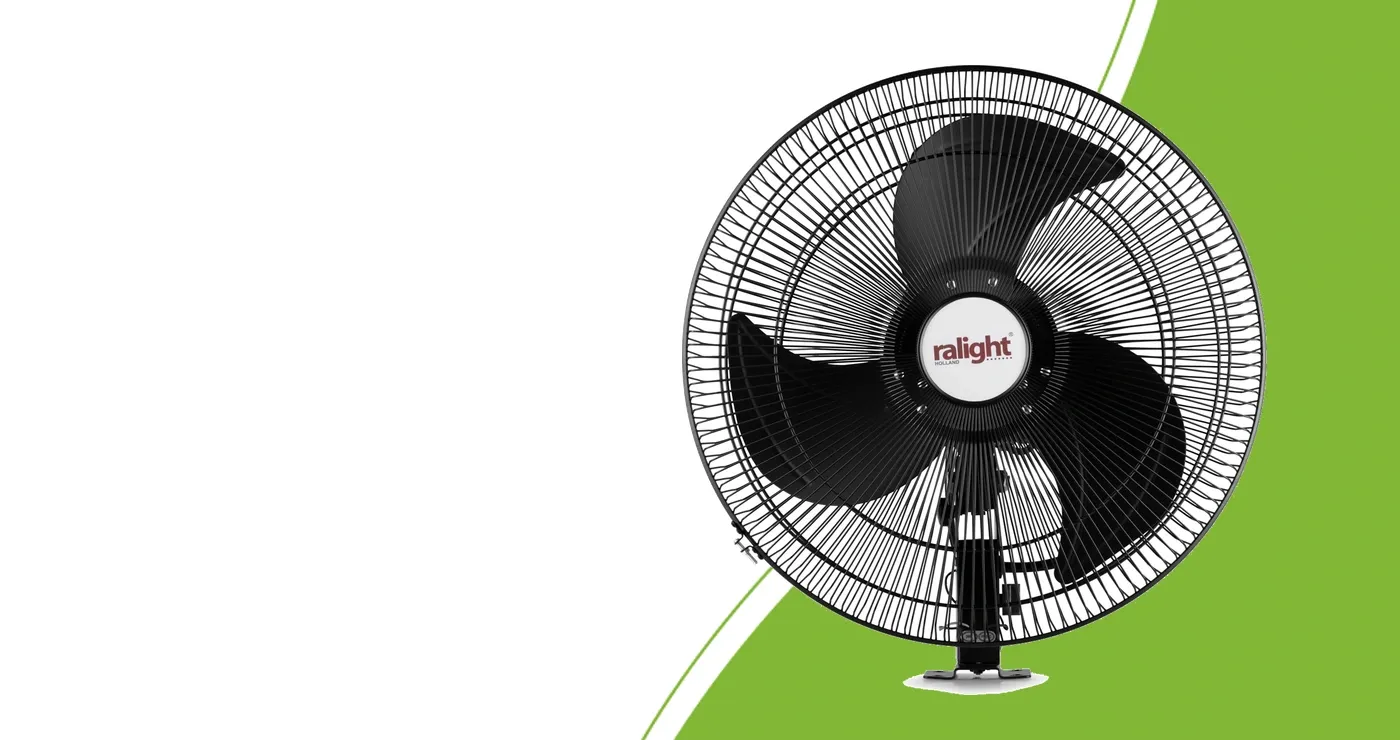
The Ralight 45 and 50 cm models in our grow tent fan selection are wall fans. A suitable wall may provide a practical mounting point in a grow room. A tent has no equivalent wall: its fabric cannot support the fan.
Check the fan weight, bracket and the permitted load of the mounting structure. A tent pole is not automatically suitable. Establish how you will secure the fan before buying, and check that the whole grille and oscillation path will remain clear. A nominal diameter of 45 or 50 cm does not describe the clearance needed for the complete unit.
Start with gentle movement
Both models offer three speed settings, oscillation and manual vertical adjustment. Start low and direct airflow across the plants. Observe leaves in several positions. Gentle movement is a useful starting point; leaves being continually flattened call for a change in speed, direction or distance.
Avoid a strong stream constantly aimed at the same plant. Oscillation can distribute movement, but check whether foliage or equipment blocks its path. Do not apply a universal distance to every fan: the speed, direction and plants affect the result.
Check corners and measure the climate
Walk around while the fan runs. Check behind larger plants, near the floor and on the far side of the canopy. Movement directly in front of the fan does not prove that airflow reaches the whole space.
Measure temperature and humidity at a representative point near the plants. If readings remain too high, assess air exchange and incoming air too. An additional circulation fan cannot replace suitable extraction or humidity control.
Recheck as plants grow
Repeat your assessment when the canopy grows taller or denser. Redirect airflow where necessary and keep the grille and bracket accessible. Keep cables and tent fabric away from moving parts and prevent water reaching the motor or connections.
Switch off and unplug the fan before cleaning or adjusting the mounting. Inspect the support and cable regularly. Stop using equipment with damaged wiring, a loose mounting point or unusual vibration until the fault has been resolved.
Our checks before buying
Is there a suitable load-bearing mounting point?
Will the complete unit fit, including its bracket and oscillation path?
Can you direct air across the plants and set a gentle enough speed?
Is fresh air exchange provided separately?
Can you reach the fan for cleaning and inspection?
These answers make choosing between the two Ralight wall fans more straightforward. Still planning the entire space? Read our guide to setting up a grow tent.